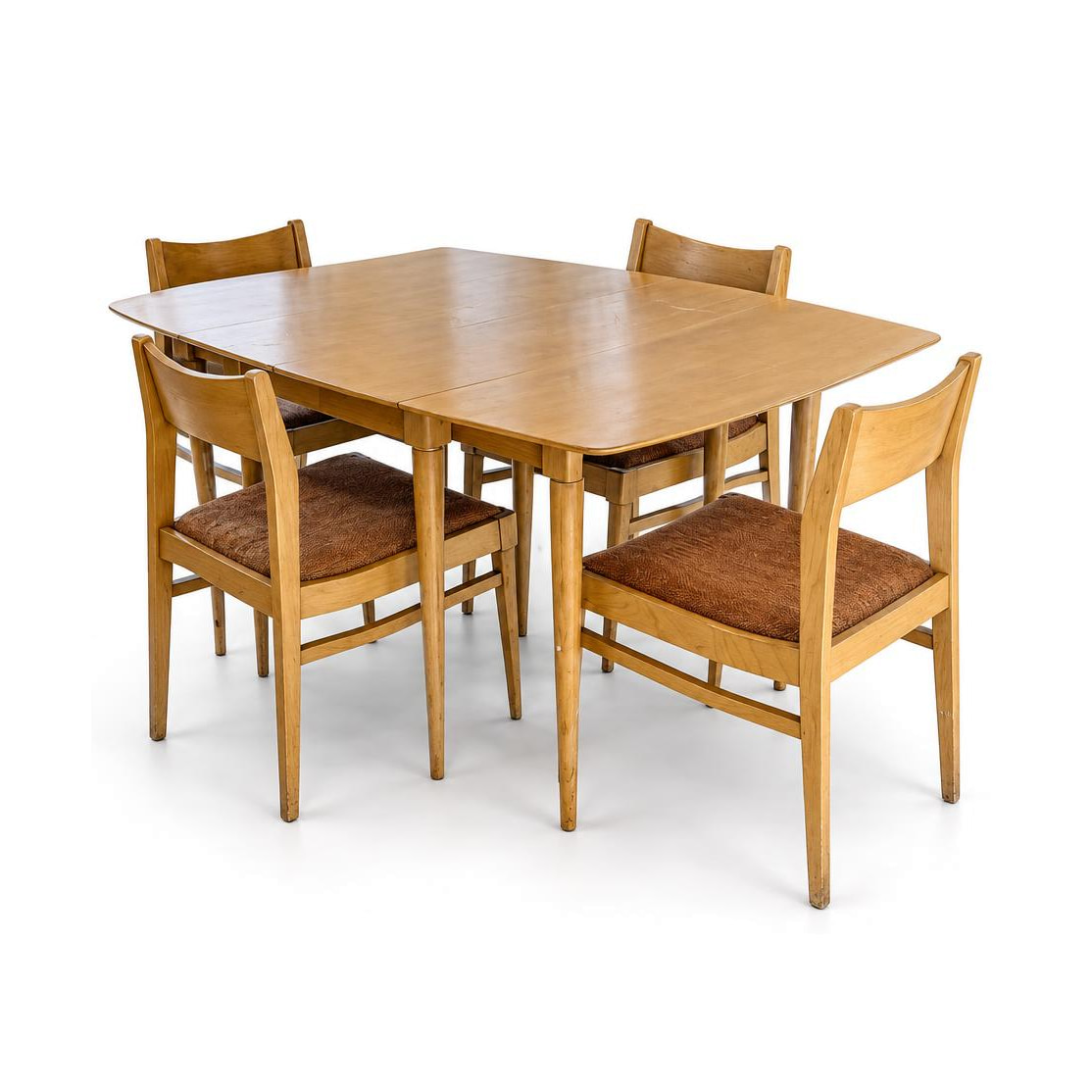
Vintage Broyhill Mid-Century Modern Drop Leaf Dining Table + 4 Chairs
Tables (F.04)$795
Broyhill was a furniture maker in Lenoir, North Carolina, founded as the Lenoir Chair Company in 1926. It made moderately priced bedroom, dining and living-room furniture, and its Broyhill Premier division produced the walnut mid-century lines Sculptra, Brasilia, Saga and Emphasis.
Ed Broyhill starts the Lenoir Chair Company in Lenoir, North Carolina, mortgaging his house to make chairs after a fire puts a supplier out of business.[1]–[3]
Broyhill adds plants in Marion and Conover; its factories are grouped as Broyhill Furniture Factories.[1]–[3]
Broyhill Premier, a higher-grade division, is introduced (Paul Broyhill later recalled it as about 1960). Sculptra is dated to the same year.[1][2][4][9][10][13]
Broyhill introduces Brasilia, a walnut line inspired by Oscar Niemeyer's buildings for the new Brazilian capital.[9]–[12]
Interco's successor, Furniture Brands International, goes bankrupt, and Broyhill passes to Heritage Home Group.[5][6][19]
Heritage Home Group files for bankruptcy, and the retailer Big Lots buys the Broyhill name.[6]–[8][17]
After Big Lots' own bankruptcy, the Broyhill brand is bought by the investment firm Gordon Brothers.[17][18]
Broyhill began with chairs and grew, plant by plant, into a maker of whole rooms of furniture: bedroom suites, dining sets, tables and upholstered seating. It aimed at the middle of the market, with sturdy wood furniture at moderate prices, in both traditional styles, such as Colonial Revival and French Provincial, and modern ones.
The modern lines that collectors look for were mostly sold under Broyhill Premier, the upper-end division started in the late 1950s. They are usually walnut veneer over solid wood frames, with the decoration carried in shaped mouldings, sculpted panels and wooden or integrated pulls. Reperch points out that veneer over a stable core was a deliberate choice, not a sign of cheap construction.[1][4][9][10][18]
Broyhill's higher-grade division rather than a single design, under which Sculptra, Brasilia, Saga and Emphasis were sold. Labels and tags read "Broyhill Premier". Company histories date it to 1957; Paul Broyhill, who ran product development, recalled it as about 1960.[1][2][4][9][14]
A Danish-influenced walnut line with applied sculpted mouldings, square-within-square door panels, recessed oval "cat's-eye" pulls and curved stretchers between tapered legs. Chairish notes pecan and mahogany parts and some tables with a hard Colorlith top.[9][10][13]
Walnut bedroom, dining and living-room pieces decorated with arches and parabolic curves taken from Oscar Niemeyer's buildings in Brasília, on drawer fronts, cabinet doors, headboards and table bases. It included dressers, nightstands, credenzas, china cabinets, dining tables and chairs and occasional tables. InCollect says it was introduced at the 1962 Seattle World's Fair and made until 1972.[9]–[12]
A Premier line of walnut dressers, chests, nightstands and other storage pieces with clean lines and tapered legs, marked by a carved starburst motif. Dealers date it from the mid-1960s.[10][12][14]
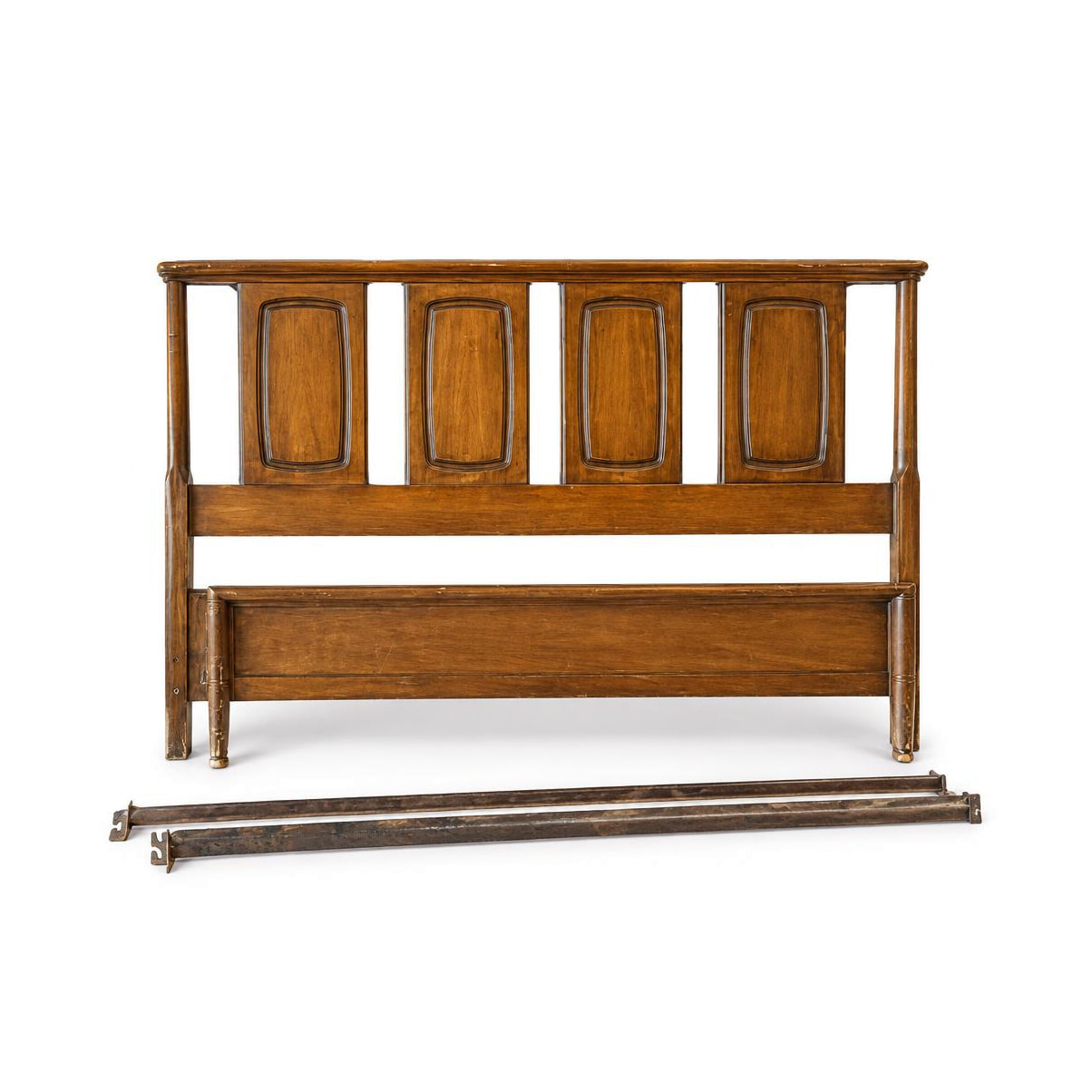
A walnut line of dressers, chests, credenzas and beds, usually sold as part of Broyhill Premier, with raised, shaped rectangular panels on drawer and door fronts and wooden pulls. Dealers date it to the 1960s.[9][15][16]
Broyhill grew out of the Lenoir Chair Company, which James Edgar (Ed) Broyhill started in Lenoir, North Carolina, in 1926. He had been working in the furniture business of his older brother, Tom, and when a fire put a chair supplier out of business he mortgaged his house for $5,000 to make chairs himself. Through the 1930s and early 1940s he bought or reopened plants in Lenoir and nearby towns, including Marion and Conover, and they were grouped as Broyhill Furniture Factories. By about 1960 the company had added Broyhill Premier, an upper-end line. Ed's son Paul Broyhill, who led product development, later ran the company, and in 1980 it was sold to Interco of St. Louis. Interco, later renamed Furniture Brands International, went bankrupt in 2013. Its successor, Heritage Home Group, filed for bankruptcy in 2018, and the Broyhill name was then bought by the retailer Big Lots.[1]–[9][16][19][20]
Look for a paper label or metal tag inside a drawer, on a drawer side, on the back of a case piece or under a table. It will read Broyhill, Broyhill Furniture Industries or Broyhill Premier. If the label is gone, compare the drawer fronts, panels and pulls with documented pieces from the line you suspect.[9][16]
A walnut bedroom, dining and living-room line introduced in 1962, decorated with arches and curves drawn from Oscar Niemeyer's architecture for Brasília. Collectors seek it out more than most Broyhill lines.[9]–[12]
Brasilia is bolder, with architectural arches and curved panels. Sculptra, which came first in 1957, uses applied geometric mouldings, square-within-square doors and recessed oval pulls set into the fronts. Both are mostly walnut and use tapered legs, so the wood alone won't separate them.[9][10]
Broyhill's upper-end division, introduced in the late 1950s. Its labels read Broyhill Premier, and the mid-century modern lines Sculptra, Brasilia, Saga and Emphasis were sold under it.[1][2][4][9]
Usually not entirely. Reperch describes mid-century Broyhill case pieces as walnut veneer combined with solid wood parts, and notes that materials varied by line and year. Sanding can cut through thin veneer, so refinishing needs care.[9]
Brasilia draws more collector interest than Broyhill's everyday furniture, and Chairish notes that original Brasilia pieces usually sell for more than the later Brasilia II. Value depends on the line, condition and originality: intact carved panels and original pulls matter, and missing or replaced parts reduce it.[9][10]
New furniture under the Broyhill name
Since 2018 the Broyhill name has belonged to retailers and investors rather than a manufacturer, and new furniture sold as Broyhill is made by licensees. When buying vintage, look for a Broyhill or Broyhill Premier label together with a line from the 1950s to the 1970s; a Broyhill label alone does not make a piece old.[8][17][18]
Looking for a piece by Broyhill? Tell Kate what you need, with the size and budget you have in mind, and she will look for one. Or write to hello@formanashville.com.
New pieces go out first in the weekly letter.
One email a week, on Thursday. What arrived, what sold and for how much, and a line or two on what we are working on.